If you’re missing a tooth — or several — you’ve probably spent some time researching your options. Bridges, dentures, implants. It can feel overwhelming, and most of what you read online is either sales copy or scare tactics. I’ve been placing dental implants at Peninsula Dentistry in Huntington Beach for over 20 years, and I want to tell you straight: implants are the closest thing modern dentistry has to giving you your natural tooth back.
This is the conversation I have with patients across the chair every week. I’m going to walk you through exactly what the process looks like, what it costs, what it feels like, and how to know if it’s the right move for you. No hype, no pressure.
What Is a Dental Implant, Exactly?
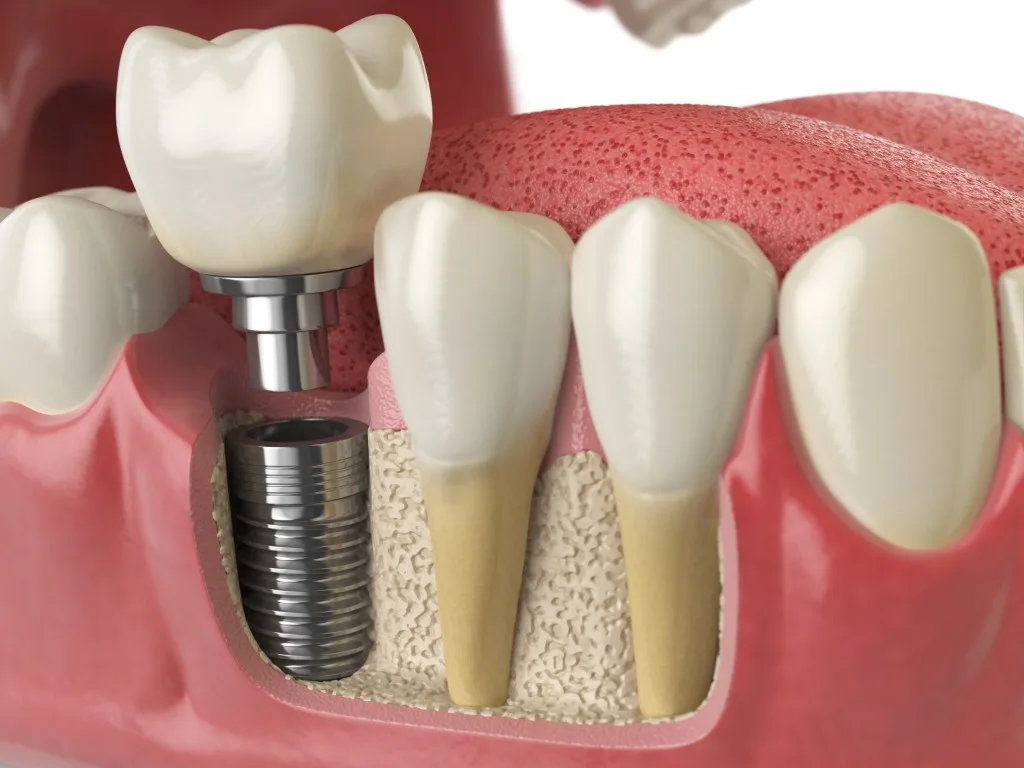
A dental implant is a small titanium post that gets placed into your jawbone where the missing tooth used to be. Think of it as an artificial tooth root. Over the next few months, the bone actually grows around the implant and locks it in place — a biological process called osseointegration. Once the implant is solid, I attach a custom crown on top that looks and functions just like a natural tooth.
The reason implants have become the gold standard isn’t marketing — it’s biology. Unlike a bridge, an implant doesn’t require me to grind down the two healthy teeth on either side of the gap. Unlike a denture, it doesn’t slip, click, or need adhesive. And unlike both of those options, it does something critical that most patients don’t hear about until it’s too late: it preserves your jawbone.

The Bone Loss Problem Nobody Tells You About
Here’s the part of the conversation I try to have early, because it changes how patients think about the decision entirely.
The moment a tooth comes out, the jawbone in that area starts to shrink. It’s not a slow, distant problem — you can lose up to 25% of the bone width in the first year alone. Without the mechanical stimulation that a tooth root provides, the body simply stops maintaining that section of bone. This is why people who have worn dentures for a long time often develop a “sunken in” facial appearance. Their jawbone has literally resorbed away.
Dental implants are the only tooth replacement option that stops this. Because the titanium post integrates with the bone and provides the same mechanical stimulation as a natural root, the bone stays healthy. For a 45-year-old patient deciding between a bridge and an implant, this isn’t a small detail. It’s the difference between preserving your face structure for the next 40 years or watching it change gradually.
I had a patient a few years ago — a retired firefighter from the Huntington Beach department — who came in for a second opinion. Another office had recommended a bridge. When I showed him his bone scan and explained what would happen to his jaw over time, he chose the implant without hesitation. That’s the kind of information I want every patient to have before making this decision.
The Step-by-Step Implant Process
People always want to know what it actually feels like and how long everything takes. Here’s the honest timeline.
Visit 1 — Consultation and 3D Imaging (60 minutes)
I start every implant case with a detailed exam and a 3D cone beam scan of your jaw. The scan lets me see exactly how much bone you have, where your nerves and sinuses are, and whether you’ll need any preparatory work before we can place the implant. I’ll also review your medical history — certain medications and conditions affect healing — and we’ll talk about your goals.
By the end of this visit, you’ll know whether you’re a candidate, what the plan looks like, what it will cost, and what your insurance covers. I don’t do surprise pricing. You leave knowing everything.
Visit 2 — Site Preparation (if needed)
Not every patient needs this step, but some do. If you’ve been missing a tooth for a while and the bone has already started to shrink, we may need a bone graft to rebuild the foundation before an implant can be placed. Bone grafting sounds dramatic but it’s actually straightforward — I use your own bone or a carefully sourced graft material, place it in the area, and let your body heal for 3-4 months before moving forward.
Similarly, if the tooth is still in place and needs to come out, I can often do an extraction and implant placement in the same visit (called an “immediate implant”). This saves you months of healing time in the right cases.
For a full explanation of when bone grafting is needed, what the procedure involves, and how it affects your timeline and cost, see my post on whether you need a bone graft before a dental implant.
Visit 3 — Implant Placement (30-60 minutes per implant)
This is the surgical step, and it’s almost always the part patients worry about the most — and almost always the part they tell me afterward was easier than they expected. The procedure is done under local anesthesia, and you feel pressure but no pain. Most patients describe it as comparable to having a tooth pulled. I’ve had patients who brought headphones and a book, and others who wanted to chat through the whole thing.
Recovery is usually 2-3 days of mild soreness, managed with over-the-counter ibuprofen. I tell my patients to take it easy for 48 hours — no heavy workouts, no swimming at the beach, no spicy food. By day four or five, most people have forgotten the implant is even there.
Visits 4-5 — Healing and Osseointegration (3-6 months)
This is where the magic happens, and also where patience comes in. The implant needs 3-6 months to fully integrate with the bone — for your jawbone to actually grow around the titanium post and lock it in permanently. During this time, I provide a temporary tooth so you’re never walking around with a visible gap. You can eat, work, smile, and go about life normally.
Visit 6 — Crown Placement (45 minutes)
Once the implant is solid, I take digital impressions and send them to our dental lab. They fabricate a custom crown that’s color-matched to your surrounding teeth — shade, translucency, surface texture, everything. Two weeks later, you come back in, I try the crown in, check the bite, and bond it permanently into place. You walk out with a tooth that looks and functions like the real thing.
Am I a Candidate for Dental Implants?
The short answer is: probably yes. The longer answer depends on a few things.
Good candidates typically have:
- Adequate jawbone density (or are willing to have a bone graft)
- Healthy gums — active gum disease has to be treated first with periodontal care
- Reasonable overall health and ability to heal from minor surgery
- Non-smoker status (or willing to stop during healing — smoking significantly affects osseointegration)
People I evaluate more carefully:
- Uncontrolled diabetes (managed diabetes is usually fine)
- Patients on bisphosphonates for osteoporosis
- Heavy grinders or clenchers (we can usually still proceed, often with a night guard)
- Patients who have had radiation therapy to the jaw
The one myth I want to dispel: you are almost never “too old” for implants. I’ve placed successful implants in patients well into their 80s. What matters is your health, your bone, and your ability to heal — not the number on your driver’s license. I had a patient a few years back, 78 years old, sharp as a tack, who had been embarrassed about his smile for a decade. We placed four implants on his upper arch, and he told me it was one of the best decisions he’d made in years. He brings his grandkids in to see me now.
How Much Do Dental Implants Cost in Huntington Beach?
Let me give you real Orange County numbers instead of the range-of-ranges you find on most websites.
For a single implant (post + abutment + crown): $3,500 – $5,500. The variation depends on whether you need a bone graft, the complexity of the placement, and the material of the crown.
Implant-supported bridge (3-4 teeth replaced with 2 implants): $6,000 – $12,000
Full-arch implant restoration (All-on-4): $18,000 – $30,000 per arch
I know those numbers can be hard to look at, but here’s the context I always share. A traditional bridge, which most people think of as the “cheaper” option, typically needs replacement every 10-15 years. A well-placed implant can last 25+ years — and many last a lifetime. The American Academy of Implant Dentistry reports success rates above 95% when placed by experienced providers. Over 20 years, the actual cost-per-year of an implant often beats the bridge or denture.
Most PPO dental insurance plans cover a portion of implant costs — usually somewhere between $1,000 and $2,500 depending on your plan. We do a full benefits check before you commit to anything. If there’s a gap, we work with CareCredit and Cherry Financing to break the cost into monthly payments that actually fit a household budget. I’d rather help you figure out how to afford the right treatment than watch you settle for something you’ll regret. Our insurance and payment page has more details.
For a deeper look at implant pricing in Huntington Beach — including what drives the variation in quotes, what insurance typically covers, and how to compare costs across providers — read my dedicated post on dental implant cost in Huntington Beach.
How I Approach Implant Cases: Dr. Tran’s Philosophy
Over 20+ years of placing implants, I’ve developed a few principles I stick to on every case.
I don’t rush the diagnosis. A 3D scan is non-negotiable. Placing an implant without proper imaging is like building a house without checking the foundation. I need to see exactly where the nerves and sinuses are, how dense your bone is, and what angle the implant needs to go in. Ten extra minutes in planning saves years of complications.
I keep the whole process under one roof. At some practices, your implant journey involves being handed off to three or four different specialists — an oral surgeon, a periodontist, a prosthodontist, a restorative dentist. Every handoff is a chance for miscommunication and a chance for someone to drop the ball. At Peninsula Dentistry, I do the planning, the surgery, and the final crown myself. I know your case from start to finish, and if something needs adjusting five years from now, I’m still your dentist.
I’m conservative about what I recommend. If a tooth can be saved with a crown or a root canal, I’ll save it. Implants are incredible, but they’re a last resort — not a first choice. I’ve had patients come in expecting me to pull and replace a tooth, and I’ve talked them out of it because the natural tooth was salvageable. Your own tooth, even a slightly compromised one, is usually the best tooth.
I tell patients the truth about timelines. Most implant cases take 4-6 months from start to finish. Some of the TV-advertised “teeth in a day” promises are misleading — yes, we can place a temporary restoration quickly in some cases, but full osseointegration still takes months. I’d rather be honest upfront than oversell and disappoint you later.
Why Choose Peninsula Dentistry for Implants in Huntington Beach
I’ll keep this short because the decision should be about what’s right for you, not about me.
I trained at NYU College of Dentistry and completed my residency at the West LA VA Medical Center, where I worked on some of the most complex restorative cases imaginable — veterans who needed full-mouth reconstruction after injuries. That background shaped how I approach every implant today. I’ve placed thousands of implants in my 20+ years in Huntington Beach, and I’ve learned what can go wrong and how to avoid it.
Our office is in the Peninsula Marketplace at Goldenwest and Garfield, easy to reach from anywhere in HB, Fountain Valley, Westminster, Seal Beach, and Costa Mesa. Most of my patients found us through word of mouth — someone in their family, someone on their block, someone at the dog park. That’s how I want it. If you want to read what actual patients have said about their experience, our reviews page has a lot of them.
For a deeper look at how implants compare to other tooth replacement options, read my post on dentures vs. dental implants — it covers the tradeoffs in detail.
Frequently Asked Questions
How painful are dental implants?
Most patients report less discomfort than expected. The procedure is done under local anesthesia, so you feel pressure but no pain. Post-operative soreness is typically managed with over-the-counter ibuprofen for 2-3 days. In my experience, patients rate the discomfort lower than a tooth extraction.
How long do dental implants last?
With proper oral hygiene and regular checkups, the titanium implant post can last a lifetime. The crown on top may need replacement after 15-20 years due to normal wear. Research consistently shows implant success rates above 95% when placed by experienced providers and maintained properly.
Am I too old for dental implants?
Almost never. Age alone isn’t a disqualifying factor — what matters is your bone density, overall health, and ability to heal. I’ve successfully placed implants in patients in their 70s and 80s. I assess each patient individually and will tell you honestly if I don’t think you’re a good candidate.
Can I get an implant if I’ve been missing a tooth for years?
Usually yes, but you may need a bone graft first. When a tooth is missing, the jawbone in that area gradually shrinks, sometimes significantly. A bone graft rebuilds the foundation so the implant has something solid to anchor into. It adds 3-4 months to the timeline but doesn’t change the end result.
How long is the full implant process?
Most straightforward cases take 4-6 months from initial consultation to final crown placement. If a bone graft is needed, add 3-4 months for that to heal first. Complex cases can take longer, but I give you a realistic timeline at your consultation — no surprises.
What happens if an implant fails?
Implant failure is rare — the National Institutes of Health reports success rates above 95% for properly placed implants. When failure does happen, it’s usually within the first few months and is almost always related to osseointegration not completing. In those cases, we remove the implant, let the site heal, and try again. The long-term outlook is excellent.
Related Reading
- Dentures vs. Dental Implants: Which Is the Better Choice for You?
- Dental Crowns vs. Veneers: Which One Do You Actually Need?
- Gum Disease Warning Signs You Shouldn’t Ignore
Thinking about dental implants and want an honest evaluation? Contact Peninsula Dentistry in Huntington Beach at (714) 374-8800 or book a consultation online. I’ll do a full exam, take a 3D scan, and walk you through every option — then you decide.

Dr. Kenneth Tran, DDS
AuthorDr. Tran earned his DDS from NYU College of Dentistry and has practiced dentistry in Huntington Beach for over 20 years. He provides comprehensive care from routine cleanings to complex implant cases at Peninsula Dentistry.