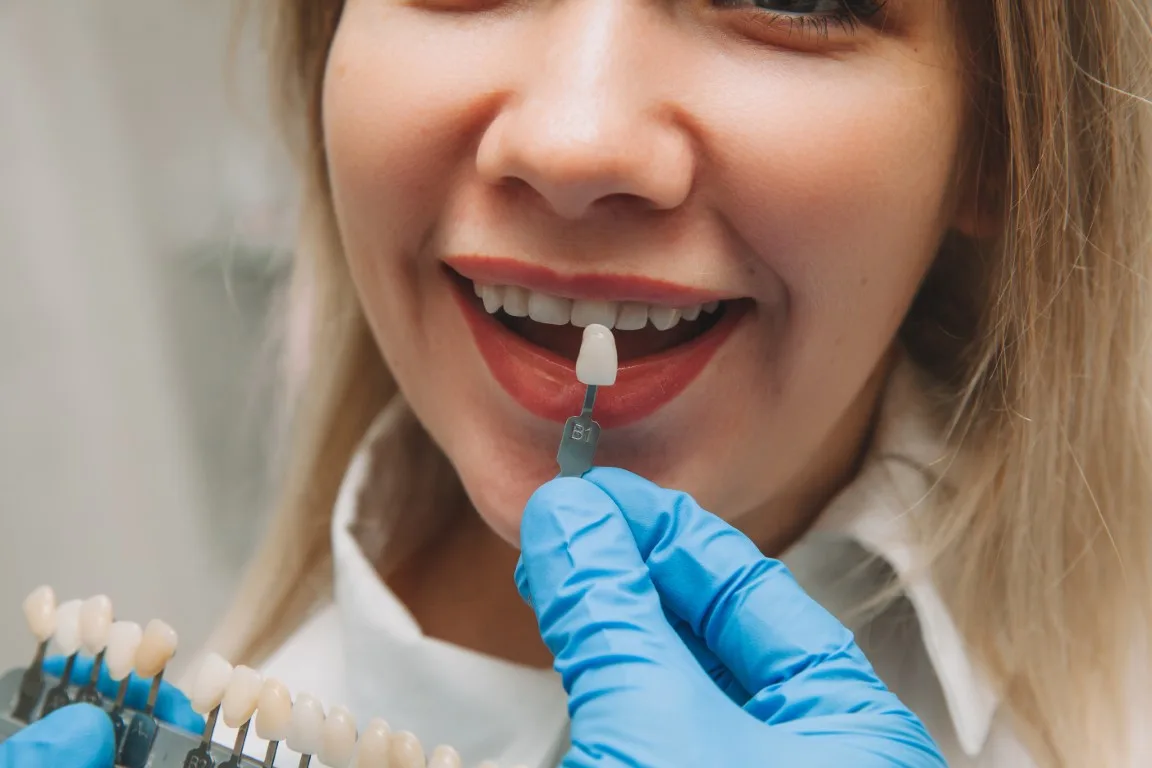
This is one of the most common conversations I have at Peninsula Dentistry — and honestly, the confusion makes sense. Crowns and veneers both go over existing teeth. They’re both made from similar materials. They can both transform a smile. So what’s the actual difference, and how do you know which one you need?
I’ve been placing crowns and veneers in Huntington Beach for over 20 years, and the answer isn’t always as obvious as you might think. Let me walk you through it the same way I explain it to patients sitting in my chair.
What Is a Dental Crown?
A crown is a cap that fits completely over a tooth — it covers the entire visible surface, all the way down to the gumline. Think of it like a helmet for your tooth. It restores the tooth’s shape, size, strength, and appearance all at once.
Crowns are typically recommended when a tooth is significantly damaged — large cavities, cracks, fractures, or after a root canal. The tooth underneath might be compromised structurally, and a crown holds everything together and protects it from further breakdown.
To place a crown, we need to reshape the tooth on all sides to make room for the cap. That means removing more tooth structure than a veneer requires. But that’s necessary because the crown needs to wrap all the way around to provide 360-degree strength and protection.
What Is a Veneer?
A veneer is a thin shell — typically porcelain — that covers only the front surface of a tooth. It’s more like a contact lens than a helmet. Veneers are primarily cosmetic: they change the color, shape, size, or length of teeth that are structurally sound but aesthetically imperfect.
We place veneers on teeth that are healthy but have issues like:
- Staining or discoloration that won’t respond to teeth whitening
- Minor chips or wear
- Gaps between teeth
- Slightly crooked or uneven teeth
- Teeth that are naturally too small or oddly shaped
The preparation is more conservative — we remove a thin layer from the front surface of the tooth (about 0.5mm), take impressions, and bond the custom porcelain shell in place. The result looks incredibly natural, and because we’re working with less tooth reduction, more of your original tooth structure stays intact.
The Key Differences (The Honest Breakdown)
Let me lay this out clearly, because this is where a lot of patients get tripped up — especially when they’ve been reading conflicting information online.
Coverage
- Crown: Covers the entire tooth (top, front, back, sides)
- Veneer: Covers only the front-facing surface
Tooth preparation
- Crown: Requires more tooth reduction (1.5-2mm from all surfaces)
- Veneer: Requires minimal preparation (0.5mm from the front surface only)
Primary purpose
- Crown: Structural restoration and protection — it’s solving a strength problem
- Veneer: Cosmetic improvement — it’s solving an appearance problem
When it’s the right choice
- Crown: Tooth has a large filling, significant decay, a crack, root canal treatment, or is structurally weak
- Veneer: Tooth is healthy and strong but cosmetically flawed
Durability
- Crown: 10-15 years average, often longer with good care
- Veneer: 10-15 years, sometimes 20+ with good care
Here’s the principle I follow: if the tooth is compromised structurally, it gets a crown. If it’s sound but just doesn’t look the way you want, a veneer is usually the better option. I never recommend a crown when a veneer will do the job, and I won’t place a veneer on a tooth that really needs the protection of a full crown.

Crown vs. Veneer vs. Bonding: Clinical Decision Matrix
Composite bonding belongs in this conversation too — especially for minor cosmetic corrections that don’t justify porcelain. Here’s how all three options compare across the scenarios I see most often:
| Clinical Scenario | Crown | Veneer | Bonding |
|---|---|---|---|
| Large cavity or significant decay | Best choice | Not appropriate | Not appropriate |
| Post-root canal tooth | Required | Not appropriate | Not appropriate |
| Cracked or fractured tooth | Required | Hairline cracks only | Hairline cracks only |
| Cosmetic staining (won’t whiten) | Not indicated | Ideal | Budget option |
| Minor chip on a front tooth | Overkill | Ideal (porcelain) | Same-visit fix |
| Gap between front teeth | Not indicated | Ideal | Works for small gaps |
| Short or worn front teeth | Back molars: yes | Front teeth: ideal | Minor wear only |
| Bridge anchor tooth | Required | Not appropriate | Not appropriate |
| Testing a cosmetic change first | Not appropriate | Not appropriate | Best choice |
| Budget-conscious cosmetic fix | — | $1,200–$2,000/tooth | $400–$800/tooth |
The short version: Crowns solve structural problems. Veneers solve cosmetic problems with minimal tooth reduction. Bonding solves minor cosmetic problems in a single visit at a lower cost — but porcelain outlasts composite by 5–10 years on average.
If a tooth needs structural protection, it gets a crown regardless of appearance. If the tooth is healthy and you want a cosmetic upgrade, the choice between a veneer and bonding usually comes down to how significant the change is, how long you want it to last, and your budget.
Explore your options:
- Dental Crowns & Bridges at Peninsula Dentistry — full-coverage restoration for damaged or compromised teeth
- Porcelain Veneers at Peninsula Dentistry — EMAX porcelain shells for a complete cosmetic transformation
- Composite Fillings & Bonding — single-visit repairs for chips, gaps, and minor imperfections
Materials: What Your Crown or Veneer Is Made Of
This is something I spend a lot of time discussing with patients because the material matters — for aesthetics, for durability, and for cost. Here’s what we use at Peninsula Dentistry and why.
EMAX (Lithium Disilicate)
EMAX is my go-to for front teeth — both crowns and veneers. It’s a type of pressed ceramic that has a translucency and depth of color that closely mimics natural tooth enamel. When it’s placed on a front tooth, it’s virtually indistinguishable from the real thing, even in bright Huntington Beach sunshine.
EMAX is strong enough for front teeth and premolars, but for back molars that take heavy chewing forces, I sometimes opt for something tougher.
Zirconia
Zirconia is the tank of dental materials. It’s incredibly strong — significantly stronger than EMAX — and virtually indestructible under normal biting forces. I use zirconia for back teeth where strength is the top priority, and for patients who are heavy grinders (bruxism).
Modern zirconia has come a long way aesthetically. The older versions looked a bit opaque and artificial, but the newer multilayered zirconia we use now has much better color gradients. It’s still not quite as lifelike as EMAX for front teeth, but it’s excellent for molars and premolars.
Porcelain-Fused-to-Metal (PFM)
This used to be the standard for decades — a metal substructure with porcelain layered on top. I still place them occasionally, but they’ve largely been replaced by all-ceramic options. The issue with PFMs is that dark metal line that can show at the gumline over time, especially if your gums recede. For most patients today, EMAX or zirconia is a better choice.
Composite Resin
For veneers, composite is a more affordable option. Instead of being fabricated in a lab, composite veneers are built directly on the tooth in a single visit. They look good initially, but they don’t last as long as porcelain and are more prone to staining. I typically use composite for patients who want to try veneers without a significant financial commitment, or for younger patients whose teeth are still developing.
Cost Comparison in Orange County
Let’s talk numbers because I know that’s on your mind. In the Huntington Beach and Orange County area, here’s what you can generally expect:
- Porcelain veneer (EMAX): $1,200 – $2,000 per tooth
- Composite veneer: $400 – $800 per tooth
- EMAX crown: $1,200 – $1,800 per tooth
- Zirconia crown: $1,000 – $1,600 per tooth
- PFM crown: $900 – $1,400 per tooth
Dental insurance typically covers crowns when they’re deemed medically necessary — a tooth that’s broken, decayed, or post-root canal. Coverage for veneers is less common because insurance companies usually classify them as cosmetic. However, there are exceptions — sometimes a veneer can be coded as a restoration if there’s structural damage involved.
At Peninsula Dentistry, our front desk team runs a full benefits check before we start treatment. You’ll know exactly what your insurance covers and what your out-of-pocket costs will be before anything happens. I don’t believe in financial surprises.
How I Decide: Dr. Tran’s Approach
Here’s how I think through it when a patient sits down and we’re discussing options.
I start with the tooth, not the treatment. I look at how much healthy tooth structure remains, whether there’s decay or damage, and what the tooth needs to function properly for the next 15-20 years. The diagnosis drives the recommendation — not aesthetics alone.
I take a conservative approach. If a tooth can be restored with a composite filling or a veneer, I won’t jump to a crown. Every time we remove tooth structure, we can’t get it back. My goal is always to preserve as much of your natural tooth as possible.
I consider the whole picture. Your bite, your grinding habits, the condition of your other teeth, and your goals for your smile all factor into the recommendation. Sometimes a patient comes in wanting veneers for their front teeth, but after we talk, they realize that whitening would accomplish the same result with zero tooth reduction.
I show you what I see. I use our intraoral cameras to show you exactly what’s going on with your tooth. You’ll see the crack, the decay, or the wear that’s driving my recommendation. I want you to understand the “why” before we talk about the “what.”
Crowns and Veneers: The Longevity Factor
Both crowns and veneers are long-term investments. With proper care, either one should last you 10-15 years at minimum, and many of my patients have restorations that have been going strong for well over 15 years.
What affects longevity:
- Oral hygiene. Crowns and veneers don’t get cavities, but the tooth underneath them can. Keep brushing and flossing around them just like you would a natural tooth.
- Grinding/clenching. If you’re a nighttime grinder, I’ll recommend a night guard to protect your investment. I’ve seen beautiful EMAX veneers crack because a patient was grinding at night and didn’t wear their guard.
- Diet and habits. Don’t open bottles with your teeth. Don’t chew ice. And if you’re eating ribeye at one of those great Huntington Beach steakhouses, be mindful of chewing on the restored side if it’s a fresh veneer.
- Regular checkups. I check every crown and veneer at every visit. Early signs of wear or loosening are easy to address before they become a problem.
Can You Get Both Crowns and Veneers?
Absolutely. It’s actually quite common. A patient might need crowns on their back teeth where structural damage exists and veneers on their front teeth for cosmetic improvement. The materials and shading are matched so everything looks cohesive.
This combination approach gives you the best of both worlds — structural integrity where you need it and minimally invasive cosmetic improvement where that’s sufficient. I work with our lab to make sure the color and translucency match across all restorations so your smile looks natural and uniform.
What the Process Looks Like at Peninsula Dentistry
Whether you’re getting a crown or veneer, here’s the general timeline:
Visit 1 — Preparation (60-90 minutes) We prepare the tooth, take digital impressions, select the shade, and place a temporary restoration. You’ll leave looking normal — the temporary is designed to protect the tooth and look presentable while the lab fabricates your permanent piece.
Lab fabrication (1-2 weeks) Our dental lab crafts your crown or veneer to the exact specifications we’ve provided — shape, shade, translucency, fit. We work with a lab that specializes in high-quality ceramic restorations.
Visit 2 — Placement (30-60 minutes) We remove the temporary, try in the permanent restoration, check the fit and bite, make any final adjustments, and bond it into place. You’ll walk out with your final result.
Some simple cases can be done in a single visit using digital fabrication, but for the highest quality aesthetic results — especially on front teeth — the two-visit approach with a dedicated lab gives us the best outcome.
Frequently Asked Questions
Can a veneer fix a broken tooth?
It depends on the extent of the break. A minor chip on a front tooth can often be fixed with a veneer. But if a significant portion of the tooth is missing or the break extends below the gumline, you’ll need a crown — or possibly a crown after a root canal. I’ll assess the damage and give you an honest recommendation.
Do crowns and veneers look natural?
With modern materials like EMAX, absolutely. The ceramics we use today have the same translucency and depth as natural enamel. I’ve placed veneers that even other dentists can’t spot. The key is material selection, proper shade matching, and working with a skilled dental lab.
How long do I have to wait between getting a crown and eating normally?
Once the permanent crown is bonded in place, you can eat normally right away. I’d recommend avoiding extremely hard or sticky foods for the first 24 hours while the cement fully sets, but after that, eat whatever you want. With the temporary crown, you’ll want to be more careful — avoid sticky or very hard foods until the permanent one goes in.
Is it painful to get a crown or veneer?
The preparation is done under local anesthesia, so you won’t feel pain during the procedure. Some patients experience mild sensitivity for a few days afterward, especially to temperature, but it resolves quickly. Most patients tell me it was much easier than they expected.
What’s the difference between a veneer and dental bonding?
Both cover the front surface of a tooth and can fix chips, staining, or gaps — but they’re different materials with different tradeoffs. Porcelain veneers are custom-fabricated in a lab from EMAX ceramic, last 15–20 years, and look virtually identical to natural enamel. Composite bonding is applied chair-side in a single visit using tooth-colored resin, costs significantly less, but typically needs replacement or touch-ups every 5–7 years. If longevity and appearance are your priorities, veneers win. If you want a low-commitment, affordable fix right now, bonding is a smart starting point.
I want a full smile makeover. Where do I start?
Start with a consultation. Come in, tell me what you don’t like about your smile, and I’ll examine your teeth and discuss every option — from whitening to veneers to crowns to a combination approach. There’s no pressure, and you’ll leave with a clear understanding of what’s possible and what it costs. Schedule a consultation and let’s talk about it.
Related Reading
- Teeth Whitening Options Compared: In-Office vs. At-Home vs. Over-the-Counter
- Dental Implants in Huntington Beach: What to Expect
Not sure whether a crown, veneer, or bonding is right for you? Dr. Tran will assess your teeth, walk you through every option, and give you an honest recommendation — no pressure. Call Peninsula Dentistry in Huntington Beach at (714) 374-8800 or book a consultation online.

Dr. Kenneth Tran, DDS
AuthorDr. Tran earned his DDS from NYU College of Dentistry and has practiced dentistry in Huntington Beach for over 20 years. He provides comprehensive care from routine cleanings to complex implant cases at Peninsula Dentistry.